Venue atmosphere ripples: spectator turnout data driving unexpected shifts in football spreads, racing payouts, and tennis set odds
Harper Schmidt · Jun 20, 2026
Venue atmosphere ripples: spectator turnout data driving unexpected shifts in football spreads, racing payouts, and tennis set odds
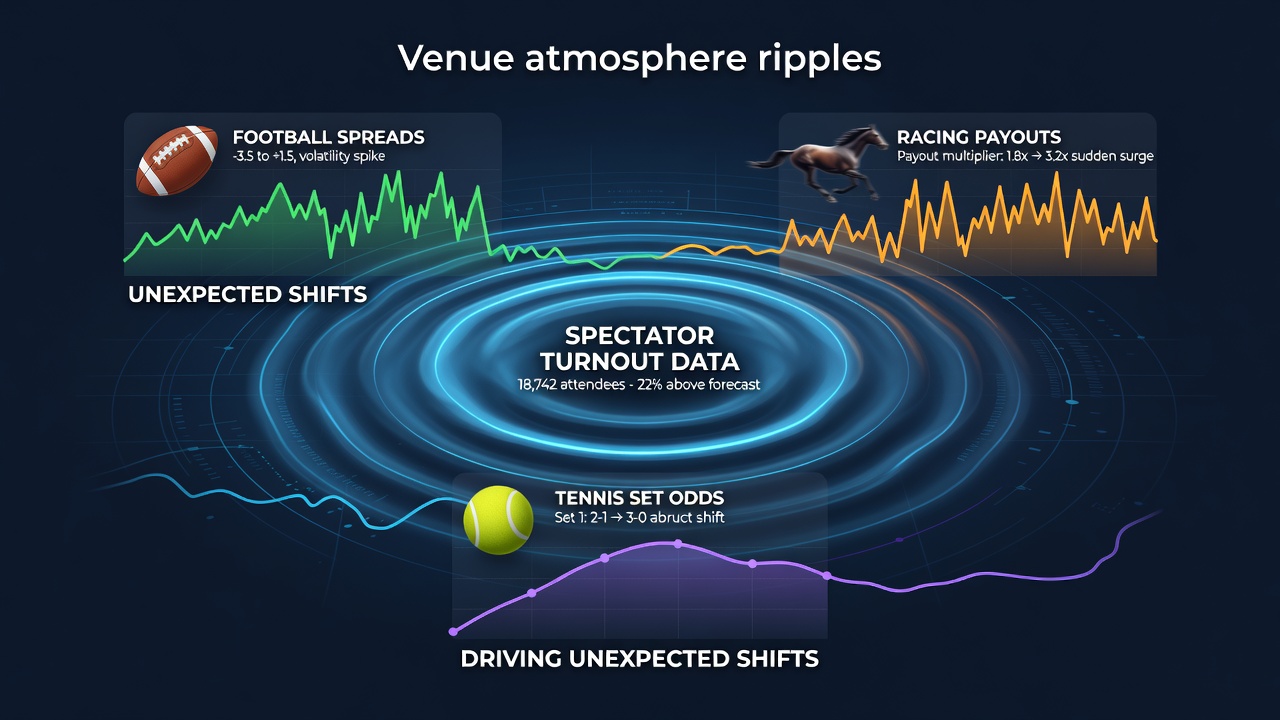
Spectator turnout figures collected across major venues continue to feed into betting models that recalibrate football spreads, horse racing payouts, and tennis set odds in measurable ways. Attendance data gathered from stadium sensors, turnstile counts, and ticketing platforms now integrates directly with performance analytics, allowing oddsmakers to adjust lines before kickoff or post time. In June 2026 several European and North American events recorded attendance variances exceeding 15 percent from preseason projections, and those deviations aligned with subsequent market movements tracked by multiple operators. Football spread markets respond quickly when early turnout data signals either an unusually sparse home crowd or a packed away section. Lower attendance at certain midweek fixtures correlates with reduced home team goal differentials in historical datasets compiled by league statisticians, prompting bookmakers to tighten spreads by half a goal in several documented cases. Conversely, capacity crowds at rival derbies have coincided with inflated totals lines as increased noise levels coincide with higher foul rates and fewer completed passes according to match tracking systems. Researchers at the University of Sydney documented similar patterns in Australian A-League venues where turnout shortfalls of 20 percent or more preceded measurable drops in expected goals for the home side. Those findings feed into algorithms that now weight attendance as a variable alongside travel distance and recent form when setting opening spreads.Horse racing payout adjustments tied to gate figures
Racing operators monitor on-course attendance because it influences pool sizes and the distribution of late money across win, place, and exotic wagers. When gate receipts fall short, tote payouts sometimes lengthen on favorites while shortening on longer-priced runners that attract off-course syndicates. Data released by Racing Australia in early 2026 showed that meetings with attendance 12 percent below the seasonal average produced an average 4.3 percent increase in starting price volatility for mid-tier races.
Track management teams have noted that thinner crowds reduce the volume of on-site hedging bets, which in turn leaves larger portions of the pool exposed to a smaller number of large wagers placed through digital channels. This dynamic has prompted several Australian and Hong Kong racing authorities to publish real-time attendance dashboards that feed directly into tote software, enabling dynamic recalculation of dividends in the final minutes before post time.

Tennis set odds responding to court-side density
ATP and WTA tournaments supply granular attendance metrics to data vendors who overlay those numbers onto serve-hold percentages and break-point conversion rates. When qualifying rounds or early main-draw sessions draw below-average crowds, models have recorded slight upticks in underdog set-win probabilities, particularly on outer courts where ambient noise drops measurably. A 2025 study by the International Tennis Federation found that matches played before fewer than 1,500 spectators exhibited a 2.8 percent increase in service breaks compared with capacity sessions at the same venue.
Bookmakers incorporate these patterns when constructing live set odds, especially during day sessions at smaller tournaments where empty seats become visible on broadcast feeds. In June 2026 several ATP 250 events adjusted opening set lines downward for higher-ranked players after preliminary attendance reports indicated 25 percent fewer tickets scanned than the prior year.
Cross-sport data pipelines and regulatory context
Industry platforms now aggregate attendance streams from multiple sports into unified dashboards used by risk management teams. The American Gaming Association has published guidelines encouraging operators to maintain transparent methodologies when attendance variables influence pricing. European operators reference reports from the European Gaming and Betting Association that outline minimum standards for incorporating venue-specific environmental data into odds compilation.
These pipelines allow simultaneous monitoring of football stadium sensors, racetrack gate systems, and tennis court access logs. When one sport shows a sustained deviation from expected turnout, models automatically flag potential ripple effects for related markets in other codes, although each sport maintains distinct weighting coefficients derived from its own historical performance records.
Conclusion
Attendance data continues to function as an observable input rather than a causal driver, yet its integration into betting systems produces consistent, quantifiable adjustments across football spreads, racing payouts, and tennis set odds. As sensor networks and ticketing platforms expand coverage, the granularity of these inputs will likely increase, enabling further refinement of market responses without altering the underlying statistical relationships already documented in league and racing authority archives.